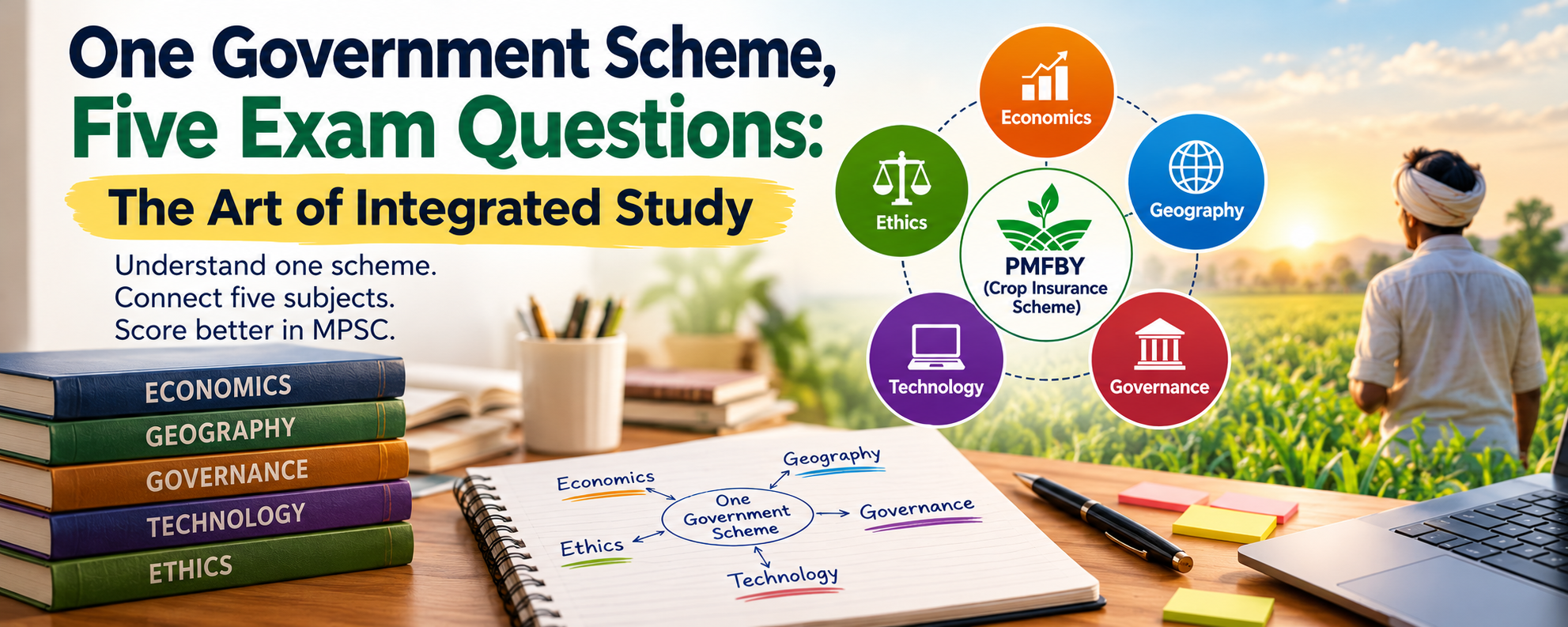
Imagine spending an hour studying a government scheme. You memorize its name, launch year, objectives and implementing ministry. The next day, you answer one direct multiple-choice question correctly. But what happens when an examiner asks how the same scheme affects farm income, interacts with monsoon geography, depends on state administration, uses technology or raises questions of fairness?
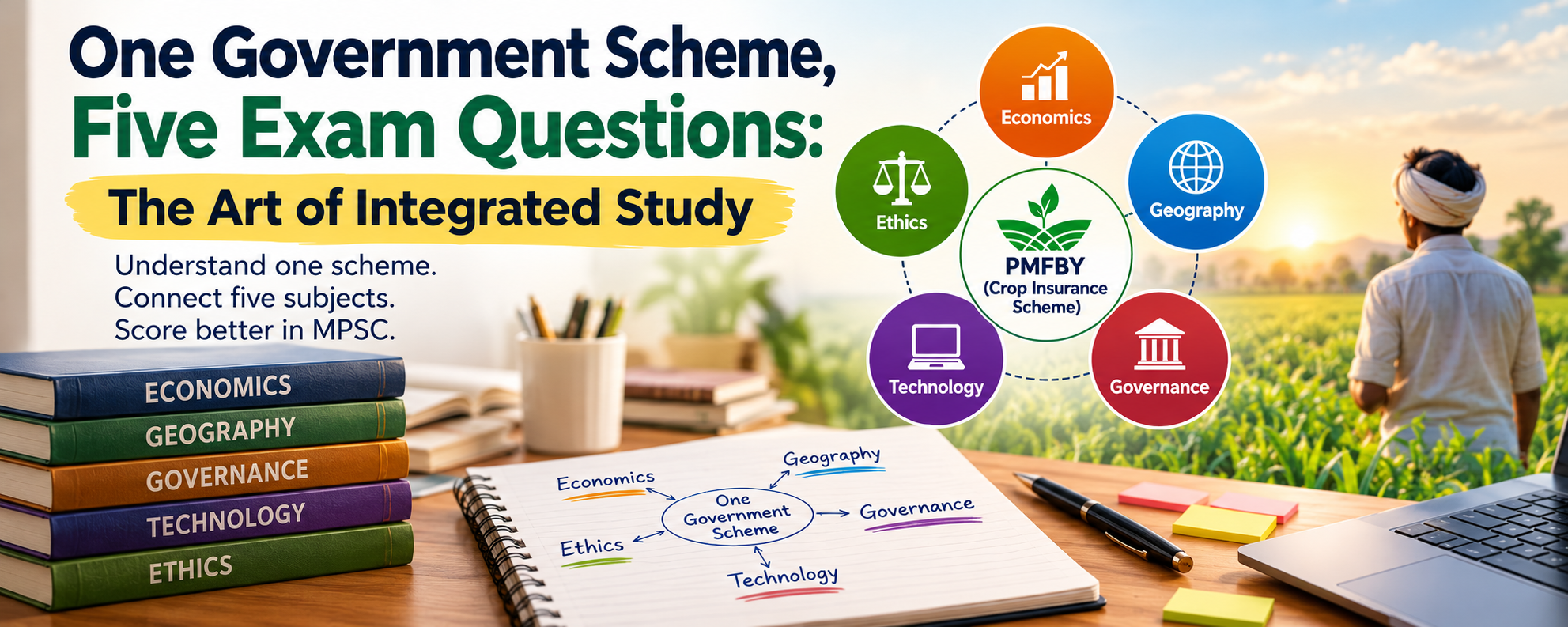
This is where integrated study for MPSC preparation becomes valuable. Instead of treating government schemes as isolated facts, connect one programme to multiple syllabus areas and examination questions.
This article demonstrates the method using the Pradhan Mantri Fasal Bima Yojana (PMFBY), a crop insurance scheme with useful links to economics, geography, governance, technology and ethics.
A launch date may help with a factual Prelims question, but it cannot by itself explain why farmers need insurance, how rainfall affects risk, who implements a scheme, or what happens when claims are disputed.
Government schemes are concrete examples of how public policy responds to economic and social problems. The goal is to understand the problem, the mechanism, the implementing institutions and the limits of the intervention.
|
Dimension |
Core question |
|
Economy |
What economic problem does the scheme address? |
|
Geography |
Which regional or environmental conditions matter? |
|
Governance |
Who implements and monitors it? |
|
Technology |
Which tools help its implementation? |
|
Ethics |
and policy Is access fair, timely and accountable? |
PMFBY was introduced from the Kharif 2016 season to provide crop insurance protection against specified non-preventable risks, subject to relevant rules. Participation by farmers is voluntary; implementation involves participating state governments and insurance companies under scheme guidelines. The Union Cabinet approved continuation of PMFBY and the Restructured Weather Based Crop Insurance Scheme through 2025-26 with an overall approved outlay of Rs 69,515.71 crore for 2021-22 to 2025-26. A Fund for Innovation and Technology of Rs 824.77 crore was also approved. These are historical figures for the stated period, not a 2026-27 budget announcement.
Maharashtra issues season-specific notifications. Always verify the applicable crop, area, conditions and deadlines before citing operational details. See the official sources at the end of this PDF.
Practice question: Explain how agricultural insurance can contribute to farm-income stability and rural economic development.
Farmers spend on seed, labour, fertiliser and equipment before knowing what their harvest will be.
Drought, excess rainfall and other insured events may cause serious loss. Insurance is intended to reduce some of the financial effects of eligible losses. It illustrates risk pooling, income stability, rural demand, farm investment decisions and public expenditure on premium subsidies.
Nashik example: An onion grower can face both adverse weather and fluctuating market prices. These are distinct problems: crop insurance is not a universal guarantee against low market prices. That distinction makes an economics answer more accurate.
Remember: risk management, rural income, insurance, subsidies, agricultural markets.
Practice question: Discuss the relationship between monsoon variability, regional agriculture and crop-risk protection.
The effects of weather differ by crop, terrain, soil, irrigation and regional rainfall. Maharashtra has contrasting rainfall conditions, from the wetter Konkan coast to comparatively dry interior regions influenced in part by the Western Ghats rain-shadow. A useful answer links rainfall variability to sowing, water availability, production and regional vulnerability.
For Nashik students, grape cultivation and commercial horticulture are useful local examples, but avoid assuming a crop is insured under PMFBY in a particular season. Notification and eligibility must be verified.
Ask: What rainfall pattern applies? Which crops are cultivated? What hazards exist? Which mitigation measures are available?
Remember: monsoon, rainfall distribution, cropping pattern, irrigation, regional disparities.
Practice question: Examine why central-state coordination matters in crop insurance implementation.
Policy does not implement itself. PMFBY links the Union government, participating state governments, designated authorities and insurance companies. The rules address functions such as notification, insurer selection, enrolment, assessment and claim procedures. Operational roles follow the applicable guidelines, rather than a simple claim that one office handles everything.
The broader concepts are cooperative federalism, clear delegation, contractual oversight, public-private coordination, grievance resolution and administrative accountability. A thoughtful answer explains both the policy design and what must happen in practice for an eligible farmer to receive the intended benefit.
Remember: federalism, implementing agencies, accountability, citizen services.
Practice question: Explain how digital tools can improve transparency and efficiency in crop insurance administration.
Remote sensing, satellite imagery, weather information, digital records and electronic processing can support agricultural monitoring and administration. Good data can improve record organization, enable review and help officials detect bottlenecks. The innovation fund approved in January 2025 provides a factual policy example.
Technology alone does not solve every problem. Incorrect records, poor connectivity, limited digital skills and disputes over assessments remain possible. Effective systems need reliable data, privacy safeguards and ways to correct errors.
Remember: remote sensing, digital governance, data quality, inclusion.
Practice question: Identify ethical challenges in crop insurance delivery and suggest safeguards.
Imagine that an eligible farmer cannot understand the documentation needed to raise a claim grievance.
An administrator should check the applicable rules, help explain the correct process, review records or direct the complaint to the proper authority. Promising immediate payment without verifying eligibility would be irresponsible.
Five useful ethical tests are accessibility, transparency, timeliness, consistent treatment and accountability.
The best answers recognise the difference between compassion and making decisions outside lawful authority.
Remember: procedural fairness, empathy, transparency, grievance redressal, integrity.
|
Subject |
PMFBY connection |
|
Economy |
Insurance, agricultural risk, rural income |
|
Geography |
Monsoon, drought, climatic variation |
|
Governance |
Central-state coordination, implementation |
|
Technology |
Remote sensing and digital records |
|
Ethics |
Fairness, complaint handling and accountability |
These five original questions illustrate the learning method. They are not presented as official previous-year MPSC questions.
This is a suggested practice routine, not a guarantee of mastery. Complex schemes may require substantially more time.
A rural housing programme could connect household assets (economics), regional construction conditions (geography), beneficiary selection (governance), digital monitoring (technology) and inclusion (ethics). The point is not to force exactly five subjects every time; it is to build meaningful connections that help students reason about new questions.
One government scheme can illuminate several areas of the MPSC syllabus. With PMFBY, we have connected crop-risk protection to agricultural economics, monsoon geography, implementation responsibilities, digital systems and citizen-focused ethics. The next time you study a scheme, ask: What problem does it solve? How does it work? Who implements it? What can go wrong? Why does the outcome matter?
Strong MPSC preparation depends on verified facts, clear concepts and the ability to apply knowledge to unfamiliar questions. Explore Karmayogi Academy's courses, practice resources and preparation guidance for Maharashtra competitive examinations at https://karmayogiacademy.com/.
Verify the latest official facts, then connect objectives and implementation with relevant economics, geography and governance concepts. Practice recall and examination questions.
It is a method of linking one issue to multiple related syllabus concepts rather than memorizing each fact in isolation.
Yes, as a case study in agriculture, insurance, governance and technology. Check your specific examination syllabus and previous papers for emphasis.
No fixed number applies. Prioritize schemes relevant to the syllabus, Maharashtra, current official decisions and previous question patterns.
It supports factual recall in objective questions and structured reasoning in descriptive answers, with depth adapted to each exam.