How Should You Prepare for MPSC & Talathi Bharti 2026 in Maharashtra?
HomeBlogs How Should You Prepare for MPSC & Talathi Bharti 2026 in Maharashtra?
Jan 30, 2026
How Should You Prepare for MPSC & Talathi Bharti 2026 in Maharashtra?
The landscape of competitive exams in Maharashtra is evolving. With the recent MPSC Combine 2025 Preliminary Exam behind us and the buzz surrounding the upcoming Talathi Bharti 2026, aspirants are standing at a critical crossroads. The question on everyone's mind is no longer just "When will the notification come?" but rather, "How do I ensure I am in the top 1% when it does?"
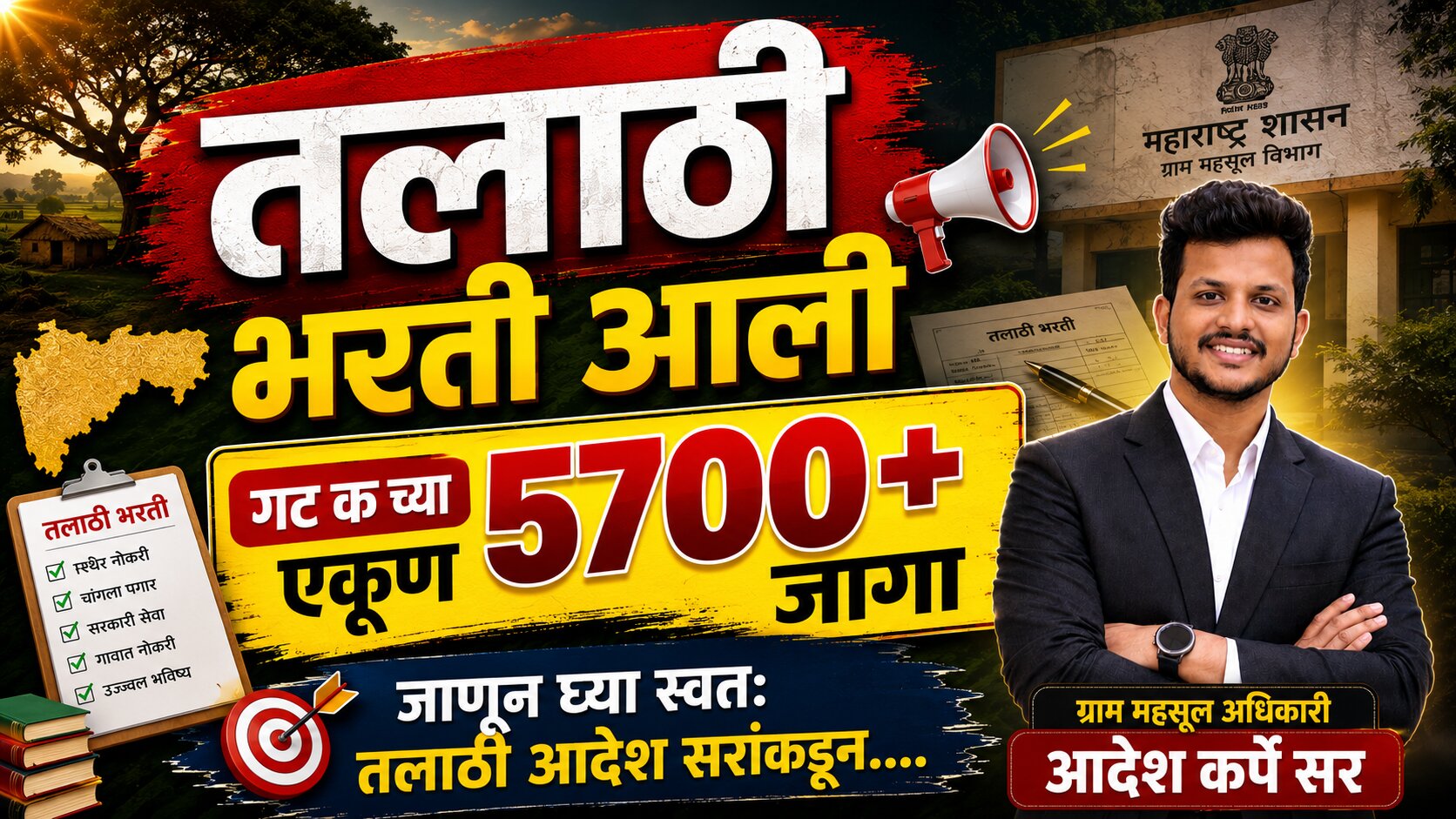
To answer this, we look at insights from those who have walked the path—like Aadesh Karpe Sir, a Revenue Officer (Talathi) who secured 190.40/200 marks in the 2024 recruitment. Whether you are aiming for the MPSC Combine (Group B/C) or the TCS/IBPS-pattern Talathi exams, success requires a shift from rote learning to strategic execution.
Understanding the 2026 Exam Landscape: MPSC vs. Saral Seva
A common point of confusion for students is the difference between the MPSC (Maharashtra Public Service Commission) pattern and the Saral Seva (TCS/IBPS) pattern. While the syllabus overlaps significantly, the execution varies:
MPSC Combine: Focuses on a two-tier structure (Prelims and Mains). The Preliminary stage is a 100-mark hurdle where speed is secondary to conceptual clarity in Polity, History, and Geography. The Mains stage involves descriptive or high-level objective papers where your analytical depth is tested.
Talathi Bharti: Typically a single-tier online exam conducted by TCS. The challenge here is the high cut-off—often exceeding 185-190 marks—and the need for lightning-fast accuracy. You are not just competing against a paper; you are competing against the clock and the precision of thousands of others in a normalized scoring environment (where your final score is adjusted based on the difficulty level of your specific shift).
The Reality of the 6,700 Expected Vacancies
There is significant speculation regarding approximately 6,700 new vacancies in the revenue department. While the official notification is the final word, the field reality suggests that many Talathis currently manage 3-4 "Sajas" (villages) simultaneously. This workload necessitates a fresh recruitment cycle to maintain administrative efficiency at the grassroots level. For a serious aspirant, the goal should be to remain "exam-ready" regardless of the notification date. If you wait for the advertisement to start, you have already lost to those who began six months prior.
Subject-Wise Strategy: Building the Foundation
To score in the 190+ range, your preparation must be surgical. Here is a breakdown based on previous year question (PYQ) trends:
1. Marathi & English Grammar (50 Questions / 100 Marks)
These are the scoring pillars. In a 200-mark exam, losing more than 4-5 marks here is often fatal to your selection chances.
Marathi: Move beyond basic vocabulary. Study Mora Walambe for conceptual depth. Focus on Prayog, Samas, and the literary works of famous authors. TCS has recently started asking about specific Marathi literature awards and "Sahityik" pen names; ensure these are in your notes.
Marathi Literature: Focus on Sahitya Akademi winners and iconic poems like those by Kusumagraj or Vinda Karandikar.
English: This is often the "elimination" section for rural students. Focus on Tense, Voice, and Direct/Indirect speech. Don't ignore vocabulary (Synonyms/Antonyms), as TCS heavily weights this. Use the "Elimination Method" for Para-jumbles—look for opening sentences and mandatory pairs rather than trying to translate the whole passage.
2. General Studies (GS) - The Game Changer
The GS section in Talathi exams is moving closer to the MPSC level in terms of "statement-based" questions.
Geography: Deep dive into Maharashtra’s river systems (Godavari, Krishna, Tapi) and their tributaries. Focus on the district-wise mineral resources and the 2011 Census data, which remains a favorite for TCS examiners.
Polity: Standard sources like Laxmikanth or simplified state board books are essential. Pay special attention to Panchayati Raj (73rd and 74th Amendments), as a Talathi’s work is deeply embedded in the local rural administration.
Current Affairs: Don't just read headlines. Focus on "Person in News," major government schemes (both Central and State-specific like Majhi Ladki Bahin), and sports. Your window should be the last 12-15 months leading up to the exam month.
3. Maths & Reasoning
In 2025, students found this section "lengthy." The trick isn't knowing how to solve a problem; it's knowing how to solve it in under 45 seconds.
Arithmetic: Master percentages, ratios, and averages. These form the base for Data Interpretation (DI).
Reasoning: Focus on Syllogisms, Blood Relations, and Seating Arrangements. TCS often provides 3-4 line word problems to build stamina for complex statements. Practice "Mental Math" to save those crucial 5-10 seconds per question spent on rough work.
A 12-Month Preparation Roadmap
Consistency beats intensity. Here is how you should structure your 2026 journey:
Phase
Timeline
Focus Area
Phase 1: Foundation
Months 1-4
Completion of State Board books (6th-12th) and basic Grammar.
Phase 2: Core Study
Months 5-8
Transition to reference books (Laxmikanth, Mora Walambe, etc.). Start daily Maths practice.
Phase 3: Application
Months 9-10
Topic-wise PYQ analysis. Identifying "weak zones" and strengthening them.
Phase 4: Revision
Months 11-12
Full-length Mock Tests, Current Affairs marathons, and formula/rule revision.
Common Pitfalls to Avoid
Based on real preparation experiences, many students fail because of:
Answer Key Obsession: Spending days arguing over unofficial keys instead of moving to the next subject. Trust the process and wait for the official response.
Resource Overload: Referring to ten different books for one subject. Stick to one standard reference and multiple revisions. Remember: "Reading one book ten times is better than reading ten books once."
The "Middleman" Myth: Always remember—recruitment through TCS/IBPS is highly transparent and computerized. Do not fall for "guaranteed selection" schemes involving money. Honest effort is the only currency that works in the digital age of recruitment.
The Psychological Aspect: Managing "Exam Hall Pressure"
Competitive exams are as much a test of temperament as they are of talent. A "tough" paper is tough for everyone; what matters is how you manage your nerves.
The 2-Pass Strategy: In the first 60 minutes, solve only the questions you are 100% sure about. This builds confidence and secures "easy" marks.
Avoiding "Ego Blocks": If a Math problem is taking more than 2 minutes, skip it. Do not let one difficult question ruin your rhythm for the remaining 99.
Mock Environment: Practice your mock tests at the same time as the actual exam shifts (e.g., 10 AM or 2 PM) to train your brain's peak performance hours.
Expert Study Tips: The "Mount Everest vs. Kalsubai" Approach
Aadesh Sir often uses a brilliant analogy: If you train to climb Mount Everest (MPSC), you will find climbing Kalsubai (Talathi/Saral Seva) much easier. By keeping your study standards high (MPSC level), you naturally cover the requirements for Saral Seva exams.
Pro-Tip: If you are a beginner or a working professional (including homemakers), consider a structured mentorship program. A guide who has actually cleared the exam (a "Talathi making a Future Talathi") can save you months of trial and error by pointing out exactly what not to read.
Conclusion: Your Name on the List
The journey to becoming a Revenue Officer in 2026 starts today. Avoid shortcuts, trust your hand-written notes, and stay consistent. The administration doesn't need the smartest person; it needs the most disciplined and resilient. Your name on the final merit list is a result of the work you do when no one is watching.