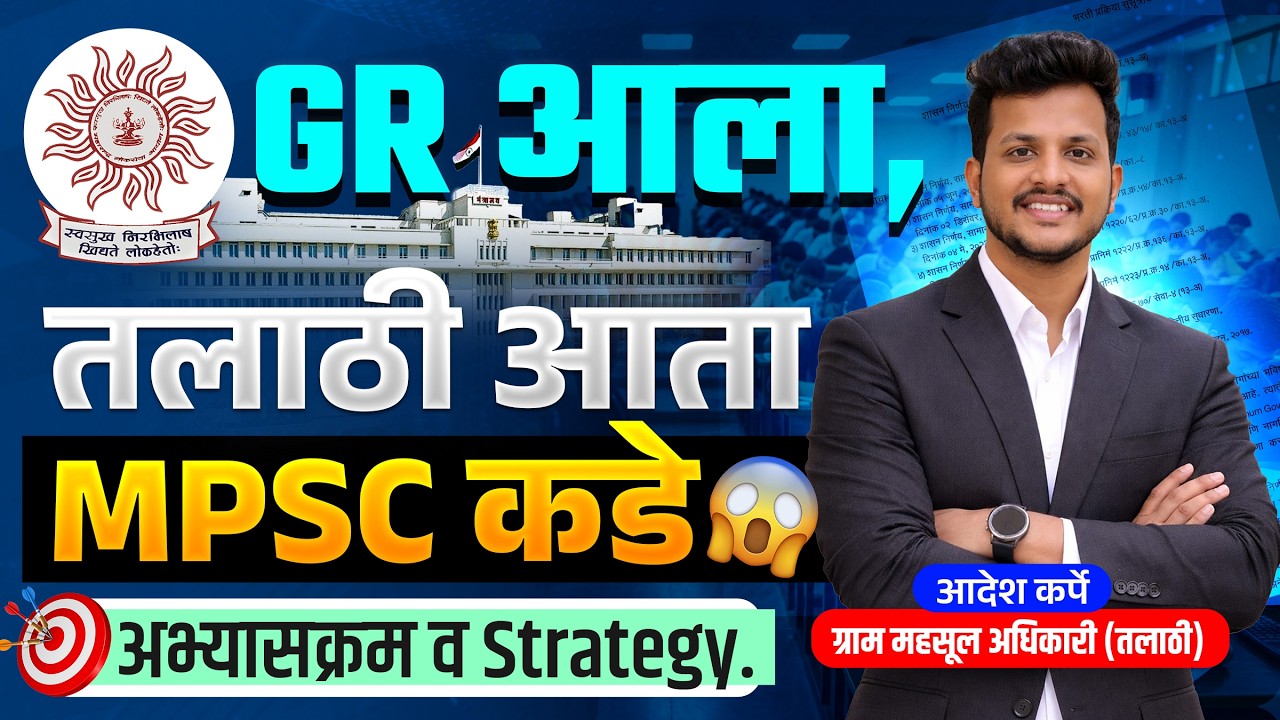
Preparing for Talathi Bharti 2026? Then there is one major change you need to understand before planning your preparation. The Talathi recruitment process is no longer following the older standalone Talathi examination structure. In 2026, 1,539 Gram Mahsul Adhikari (Talathi), Group C posts have been included in the Maharashtra Group-C Services Combined Examination 2026 conducted by MPSC.
This means aspirants need to prepare according to the MPSC Group C examination pattern, not simply repeat the strategy used for the previous Talathi recruitment.
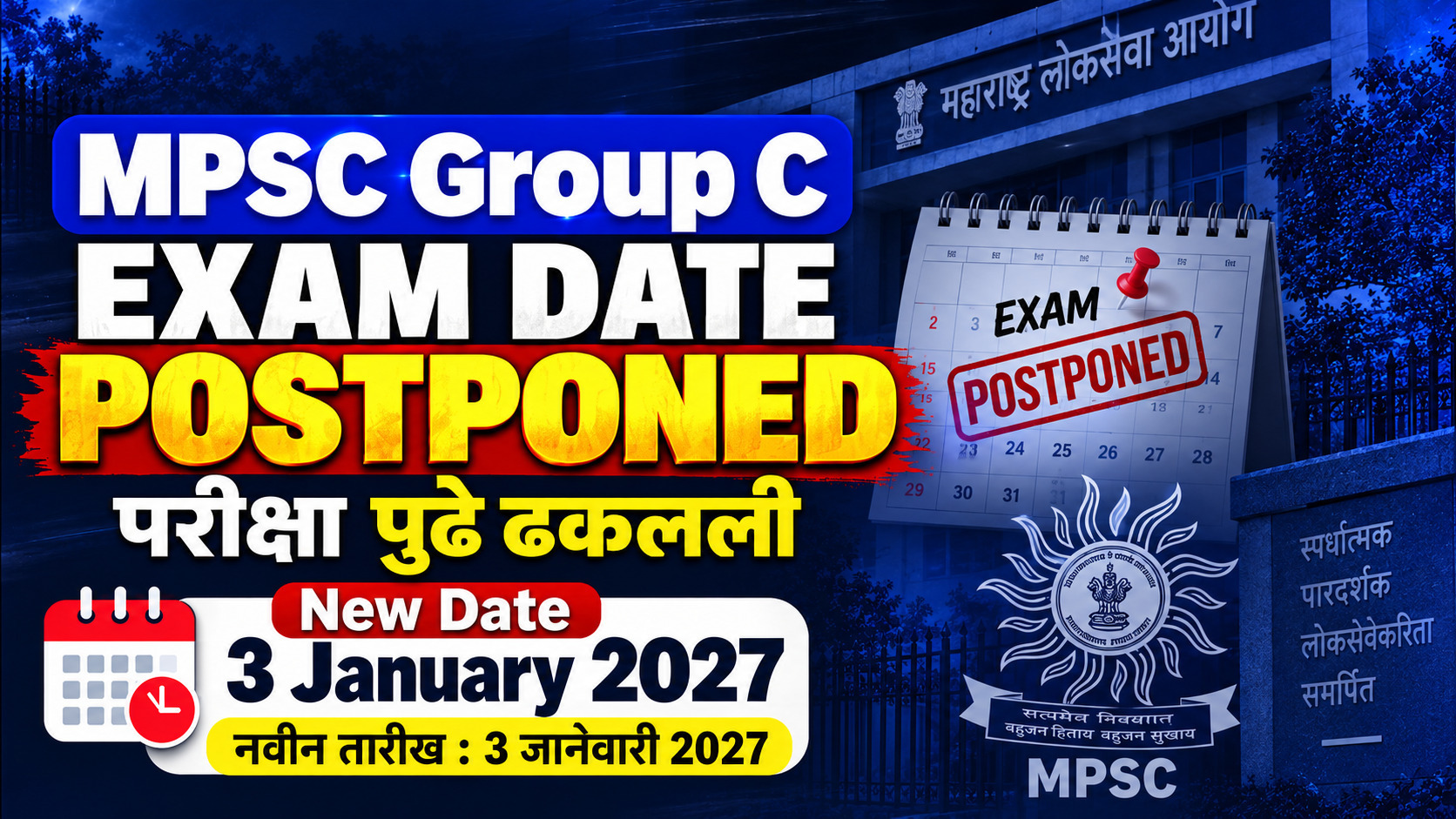
The Maharashtra Group-C Services Combined Preliminary Examination 2026, which was earlier scheduled for 25 October 2026, has now been postponed to 3 January 2027.
For Talathi aspirants, this additional preparation window can be extremely valuable—but only if it is used strategically. This updated guide explains the Talathi Bharti 2026 syllabus, exam pattern, negative marking, eligibility, preliminary examination subjects and preparation strategy in one place.
|
Post |
Gram Mahsul Adhikari (Talathi), Group C |
|
Department |
Revenue and Forest Department, Maharashtra |
|
Talathi Vacancies |
1,539 |
|
Recruitment |
Maharashtra Group-C Services Combined Examination 2026 |
|
Advertisement |
017/2026 |
|
Total Revised Group C Vacancies |
5,707 |
|
Previous Preliminary Exam Date |
25 October 2026 |
|
New Preliminary Exam Date |
3 January 2027 |
|
Exam Mode |
Offline OMR |
|
Prelims |
100 Questions | 100 Marks | 60 Minutes |
|
Negative Marking |
1/4 or 25% for an incorrect answer |
|
Educational Qualification |
Graduation from a recognised/statutory university |
The inclusion of 1,539 Talathi vacancies came through the revised MPSC Group C recruitment, which increased the overall number of Group C vacancies to 5,707.
The MPSC Group C Combined Preliminary Examination was previously scheduled for 25 October 2026. MPSC has subsequently revised the schedule.
New MPSC Group C / Talathi Prelims Date
3 January 2027. Talathi is part of this Group C Combined recruitment, so candidates targeting Gram Mahsul Adhikari posts will also appear through this examination process.
The postponement gives aspirants additional time for preparation, but simply extending your existing timetable is not enough. Use this period to improve previous-year-question practice, revision, mock-test performance, accuracy, time management and Maharashtra-focused general studies.
Many aspirants are still searching for the older Talathi exam pattern: 100 questions × 2 marks = 200 marks in 120 minutes. That format should not be used as your primary preparation framework for the 2026 recruitment.
Talathi has now been brought into the MPSC Group C Combined Examination structure. Therefore, the preparation approach has changed significantly.
Previous Talathi recruitments followed a more direct recruitment structure with subjects such as Marathi, English, General Knowledge, Mathematics and Reasoning.
The 2026 recruitment follows the MPSC Group C structure: Stage 1 – Combined Preliminary Examination followed by Stage 2 – Main Examination.
|
Examination |
MPSC Group C Combined Preliminary Examination |
|
Type |
Objective MCQ |
|
Questions |
100 |
|
Marks |
100 |
|
Duration |
60 Minutes |
|
Standard |
Degree Level |
|
Mode |
Offline OMR |
|
Medium |
Marathi and English |
|
Negative Marking |
1/4 mark / 25% deduction for an incorrect answer |
The biggest challenge here is not simply syllabus coverage. It is speed plus accuracy. You effectively have around 36 seconds per question if you divide the full 60 minutes equally across 100 questions.
Yes. Under the MPSC Group C examination scheme, 25% or one-fourth of the marks allotted to a question may be deducted for an incorrect response.
Negative marking makes accuracy one of the most important factors in Talathi preparation.
Focus on important developments in Maharashtra, India and international affairs. Give special attention to Maharashtra government schemes, important appointments, economic developments, awards, reports, sports, science and technology and other major current events. Revise current affairs repeatedly through MCQs.
Prepare Modern Indian History with reference to Maharashtra, including the freedom movement, British rule, Maharashtra’s role in the freedom struggle, social and religious reform movements and important Maharashtra reformers.
Build a strong Maharashtra orientation: physical geography, districts, rivers, soil types, rainfall, climate, agriculture, major crops, cities, industries, natural resources and important geographical features of India and the world.
Cover Indian economy, Maharashtra economy, agriculture, industry, banking, national income, poverty, unemployment, population, inflation, fiscal policy, monetary policy, government budgeting and public finance.
Study the Indian Constitution, Fundamental Rights, Directive Principles, Parliament, State Legislature, President, Governor, Chief Minister, local self-government, Panchayati Raj, constitutional bodies, Maharashtra administration and government schemes.
Prepare fundamental concepts from Physics, Chemistry, Biology, Botany, Zoology and Health Science, with emphasis on competitive-exam level concepts and daily-life applications.
Practise basic operations, fractions, decimals, percentages, ratio and proportion, average, profit and loss, simple and compound interest, time and work, time-speed-distance and basic numerical aptitude.
Practise number series, alphabet series, analogy, classification, coding-decoding, direction sense, blood relations, logical sequences, odd-one-out and other reasoning-based questions.
Candidates qualifying through the Combined Preliminary Examination move to the next stage of the MPSC Group C selection process. Under the revised Group C scheme, Group C cadres other than AMVI follow a two-paper Main Examination carrying a total of 400 marks.
The exact detailed syllabus notified by MPSC for the Talathi/Gram Mahsul Adhikari cadre should be followed while preparing for the Main Examination.
For the Gram Mahsul Adhikari (Talathi), Group C posts included in the 2026 MPSC recruitment, candidates need a graduation degree from a recognised/statutory university as prescribed in the recruitment notification.
This is important because some older Talathi-related information online may still show outdated qualification details. Always use the current MPSC Advertisement No. 017/2026 and subsequent corrigenda while checking eligibility.
MPSC’s revised recruitment added 1,539 Gram Mahsul Adhikari posts under the Revenue and Forest Department. The broader MPSC Group C recruitment now contains 5,707 vacancies after the revised additions.
For graduates seeking a Maharashtra government job, Talathi is therefore one of the major opportunities in the current Group C recruitment cycle. A larger opportunity is likely to attract a larger applicant pool, so your strategy should focus on achieving a competitive score—not simply completing the syllabus.
Take one full-length MPSC Group C-level mock examination. Classify every lost mark into a conceptual mistake, memory mistake, calculation error, careless mistake or time-management problem.
Prioritise the official Preliminary Examination subjects. Choose limited reliable sources for every subject and complete them systematically instead of jumping between books, PDFs and videos.
Use PYQs to understand question framing, difficulty level, repeated concepts, option patterns and the depth required by MPSC. Analyse why the wrong options are wrong.
Shift gradually from reading toward problem-solving: Study → MCQs → Review mistakes → Revise concept → Retest.
Before January, become comfortable solving 100 questions within 60 minutes. Simulate the real examination and analyse every mock on the same day.
Do not measure your performance only by the number of questions attempted. Measure Attempts + Accuracy + Final Score.
After several tests, you will begin to understand your safest attempt range and the question types that create unnecessary negative marks.
If you are preparing for Talathi Bharti 2026 in Nashik, your preparation now needs to be aligned with the MPSC Group C pattern. Karmayogi Academy provides structured preparation for Maharashtra competitive examinations, including MPSC Group B & C, Talathi and other government recruitment examinations.
For candidates searching for Talathi classes in Nashik or MPSC Group C classes in Nashik, structured guidance can be especially useful now that Talathi recruitment has moved into the MPSC Group C examination framework.
What is the Talathi Bharti 2026 exam date?
The MPSC Group C Combined Preliminary Examination that includes Talathi recruitment is now scheduled for 3 January 2027. It was previously scheduled for 25 October 2026.
How many Talathi vacancies are there in 2026?
A total of 1,539 Gram Mahsul Adhikari (Talathi), Group C vacancies have been added under the Maharashtra Group C Services Combined Examination 2026.
Is Talathi Bharti 2026 conducted by MPSC?
Yes. The 1,539 Talathi posts have been included in the MPSC Maharashtra Group-C Services Combined Examination 2026 under Advertisement No. 017/2026.
What is the Talathi Prelims exam pattern for 2026?
The MPSC Group C Combined Prelims consists of 100 objective questions for 100 marks with a duration of 60 minutes.
Is there negative marking in Talathi Bharti 2026?
Yes. The MPSC Group C examination follows 1/4 or 25% negative marking for incorrect answers.
What is the educational qualification for Talathi Bharti 2026?
Candidates applying for the Gram Mahsul Adhikari (Talathi) post need a graduation degree from a recognised/statutory university, subject to the complete eligibility requirements in the official notification.
Is the old 100-question, 200-mark Talathi pattern applicable in 2026?
Candidates should prepare according to the current MPSC Group C Combined Examination framework rather than relying on the older standalone Talathi recruitment pattern.
Which subjects should I study for Talathi Prelims 2026?
The Combined Preliminary Examination includes Current Affairs, History, Geography, Economics, Political Science, General Science, Arithmetic and Intelligence Test.
Where can I join Talathi classes in Nashik?
Karmayogi Academy provides structured competitive-exam preparation in Nashik for aspirants targeting Talathi and MPSC Group C examinations.
Talathi Bharti 2026 is fundamentally different from the previous standalone Talathi recruitment pattern.
The 1,539 Gram Mahsul Adhikari vacancies are now part of the MPSC Group C Combined recruitment, and the revised Preliminary Examination date of 3 January 2027 gives candidates additional preparation time.
Use it wisely. Strengthen fundamentals. Solve PYQs. Practise MCQs. Take timed mock tests. Analyse every mistake. Revise repeatedly. And build the speed and accuracy required to handle 100 questions in 60 minutes with negative marking.
The exam date may have moved. Your preparation should move forward.