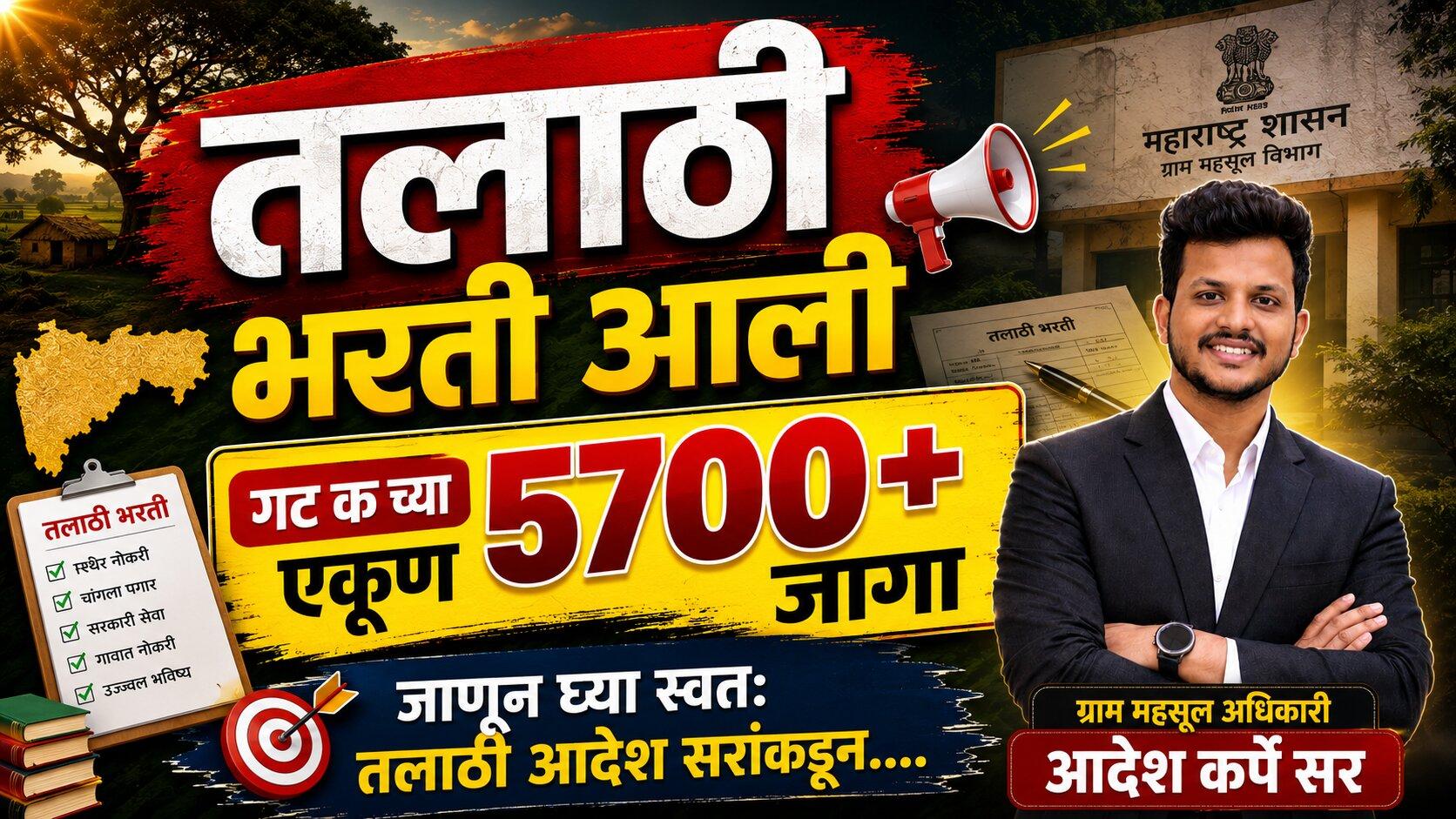
Talathi Bharti 2026 (तलाठी भरती 2026) represents an important opportunity for graduates aspiring to join the Maharashtra Government’s Revenue and Forest Department. However, the recruitment process has undergone significant changes compared to the previous Talathi examination.
The Talathi post, officially referred to as Gram Mahsul Adhikari (ग्राम महसूल अधिकारी), is included in the Maharashtra Public Service Commission’s Group C Services Combined Examination for the 2026 recruitment cycle, according to the recruitment information in the original draft.
Under the referenced MPSC Group C preliminary examination scheme, candidates must prepare for 100 objective questions carrying 100 marks, with a duration of 60 minutes and negative marking of 25% of the marks assigned to an incorrectly answered question. Understanding the revised examination structure, syllabus and selection process is essential for effective preparation.
This guide explains the recruitment updates, preliminary and main examination patterns, subject-wise syllabus, marking scheme and practical preparation strategies.
Talathi Bharti 2026 – Latest Recruitment Updates
The Maharashtra Public Service Commission (MPSC) has included Gram Mahsul Adhikari (Talathi) recruitment under the Maharashtra Group C Services Combined Preliminary Examination 2026, as reported in the recruitment information referenced in this draft.
The original recruitment advertisement was dated 25 June 2026. Subsequently, the Talathi cadre was included through a corrigendum dated 22 July 2026. Following the reported revised recruitment announcement in November 2026, the number of Talathi vacancies increased from 1,539 to 1,840. The combined Group C recruitment reportedly covers 16,717 vacancies across various departments and cadres.
Important Talathi Bharti 2026 Dates
• Original MPSC advertisement: 25 June 2026
• Inclusion of Talathi posts: 22 July 2026
• Revised recruitment corrigendum: 6 November 2026
• Application window reopened: 13 November 2026
• Extended application deadline: 29 November 2026
• Online examination fee deadline: 30 November 2026
• Revised preliminary examination date: 24 January 2027
• Main examination date: Awaiting official announcement
The recruitment is identified as the 2026 cycle even though its reported preliminary examination date falls in January 2027. Candidates should check the official MPSC website for further announcements, examination instructions, admit cards and revised schedules. Confirm all dates and vacancies against the latest official notification before applying.
Talathi Bharti 2026 – Examination Overview
• Examination: Maharashtra Group C Services Combined Examination 2026
• Post name: Gram Mahsul Adhikari (Talathi)
• Department: Revenue and Forest Department, Maharashtra
• Recruiting authority: Maharashtra Public Service Commission
• Talathi vacancies: 1,840 (reported)
• Total Group C vacancies: 16,717 (reported)
• Preliminary examination mode: Offline OMR-based examination
• Question type: Objective multiple-choice questions
• Preliminary examination marks: 100
• Preliminary examination duration: 60 minutes
• Negative marking: 25% of the question’s marks
• Examination medium: Marathi and English for prelims
• Selection process: Preliminary examination, main examination and applicable eligibility verification
• Official website: https://mpsc.gov.in/
Candidates must refer to the latest MPSC advertisement and corrigenda for post-specific eligibility and selection requirements.
Talathi Bharti 2026 Exam Pattern
The revised Talathi recruitment structure requires candidates to prepare according to the applicable MPSC Group C combined examination framework rather than relying exclusively on the previous standalone Talathi examination pattern.
Preliminary Examination Pattern
The preliminary examination is a common screening examination for participating Group C cadres.
• Paper: General Ability Test (सामान्य क्षमता चाचणी)
• Total questions: 100
• Total marks: 100
• Marks per correct answer: 1
• Examination duration: 60 minutes
• Question type: Objective MCQs
• Difficulty level: Graduation level
• Examination medium: Marathi and English
• Negative marking: 0.25 marks per incorrect answer
The referenced preliminary syllabus consists of eight broad subject areas: history, geography, economics, current affairs, political science, general science, arithmetic and intelligence test.
A guaranteed number of questions for every individual subject is not specified in the referenced preliminary syllabus. Candidates should avoid relying on unofficial fixed subject-wise marks distributions. The preliminary examination primarily determines eligibility for the main examination; its marks are not normally included in final merit under the referenced scheme.
Main Examination Pattern
The MPSC Group C administrative-cadre main examination follows a two-paper structure under the referenced examination scheme dated 20 May 2026. The November 2026 examination scheme corrigendum was reported to retain a combined main examination for administrative cadres requiring general educational qualifications, with certain detailed mains and result-related provisions subject to further amendments.
The following structure is a preparation reference based on the existing Group C administrative examination scheme, not a separately verified final Talathi mains notification.
• Paper 1 — Marathi; Questions: 50; Marks: 100
• Paper 1 — English; Questions: 50; Marks: 100
• Paper 2 — General Studies and Intelligence Test; Questions: 100; Marks: 200
• Total; Questions: 200; Marks: 400
Under the referenced scheme, each paper has a duration of 60 minutes. Candidates should prepare for language proficiency and general studies while monitoring the MPSC examination scheme for additional amendments.
Negative Marking and Marking Scheme
The referenced MPSC Group C preliminary scheme specifies negative marking equivalent to one-fourth of the marks assigned to an incorrect answer.
• Correct answer: +1
• Incorrect answer: −0.25
• Unanswered question: 0 under the referenced scheme, subject to current instructions
Candidates must follow the latest examination-day instructions regarding OMR marking, unanswered questions and any applicable answer-option requirements.
Example of preliminary examination score calculation: Suppose a candidate answers 75 questions correctly, 15 incorrectly and leaves 10 unanswered. Under the illustrated marking rules:
• Correct answers: 75 × 1 = 75 marks
• Incorrect answers: 15 × 0.25 = 3.75 marks deducted
• Unanswered questions: 0 marks
Final score = 75 − 3.75 = 71.25 marks. This example illustrates why accuracy is important. Attempting questions without sufficient knowledge can reduce the overall score.
Talathi Bharti 2026 Complete Subject-Wise Syllabus
The Talathi preliminary examination preparation should be based on the applicable MPSC Group C combined preliminary examination syllabus. The following sections explain the listed subject areas along with recommended supporting preparation topics. These topic lists are preparation guidance, not an official chapter-wise marks distribution.
1. History (इतिहास)
The referenced syllabus emphasises modern Indian history, particularly the history of Maharashtra. Recommended preparation topics include:
• British rule in India and the Revolt of 1857
• Indian freedom movement and Indian National Congress
• Social and religious reform movements
• Maharashtra’s contribution to the independence movement
• Important social reformers, historical organisations and movements
Pay particular attention to Maharashtra’s social reform movement, including the contributions of Mahatma Jyotirao Phule, Savitribai Phule, Rajarshi Shahu Maharaj and Dr. B. R. Ambedkar. Prepare chronological notes rather than memorising events independently.
2. Geography (भूगोल)
Give special importance to Maharashtra while covering essential geographical concepts.
• Physical geography, latitude and longitude
• Climate and rainfall
• Maharashtra’s geographical divisions
• Major rivers and drainage systems
• Soil types, agriculture and major crops
• Important cities, industries and natural resources
Use Maharashtra maps to connect rivers, mountain ranges, agricultural regions and administrative divisions. Map-based revision improves understanding and retention.
3. Economics (अर्थव्यवस्था)
Cover fundamental aspects of the Indian economy and government finance.
• National income, agriculture and industrial development
• Banking and foreign trade
• Population, poverty and unemployment
• Monetary and fiscal policy
• Government budgets, public accounts and auditing
For additional preparation, study Maharashtra’s economic development, agricultural challenges and welfare programmes. Understand concepts through practical examples rather than memorising definitions alone.
4. Current Affairs (चालू घडामोडी)
Cover important developments in Maharashtra, India and the world.
• Government policies and schemes
• Maharashtra state developments, national and international events
• Economic announcements, science and technology developments
• Environmental issues, awards and honours
• Important reports and indices, sports-related developments
Maintain short, topic-wise notes and revise them weekly. When studying a government scheme, understand its objectives, implementing authority, beneficiaries and significance.
5. Political Science and Indian Polity (राज्यशास्त्र)
Build preparation around fundamental constitutional and administrative concepts.
• Indian Constitution, Fundamental Rights and Fundamental Duties
• Directive Principles of State Policy
• Parliament, President and Prime Minister
• Governor, Chief Minister and State Legislature
• Judiciary, Panchayati Raj and local self-government
Understanding the relationship between state administration and local government is particularly useful for aspiring revenue officials.
6. General Science (सामान्य विज्ञान)
The referenced subject area includes physics, chemistry, zoology, botany and hygiene.
• Motion, energy and electricity
• Basic chemical reactions, acids, bases and salts
• Human body systems, nutrition and health
• Common diseases and prevention
• Plants and animals, everyday applications of science
Maharashtra State Board science textbooks can provide a useful foundation for conceptual preparation.
7. Arithmetic (अंकगणित)
Arithmetic requires regular practice and strong calculation skills. The referenced syllabus includes basic mathematical operations, decimals, fractions and percentages. Additional recommended topics include:
• Ratio and proportion, average
• Profit and loss, simple and compound interest
• Time and work, speed, time and distance
• Basic numerical problem-solving
Learn standard calculation methods before using shortcuts. Regular timed practice improves speed and accuracy.
8. Intelligence Test and Logical Reasoning (बुद्धिमत्ता चाचणी)
The intelligence test evaluates analytical ability, reasoning and the speed and accuracy of thinking. Recommended topics include:
• Number and alphabet series, coding and decoding
• Analogy and classification
• Direction sense and blood relations
• Logical sequences, analytical reasoning and basic problem-solving
Practise a combination of easy, moderate and difficult questions to develop a flexible approach.
Talathi Bharti 2026 Main Examination Syllabus
Under the referenced Group C administrative mains syllabus, candidates should prepare for Marathi, English, General Studies and Intelligence Test.
Marathi Language
Focus on vocabulary, grammar, sentence structure, idioms, proverbs and reading comprehension. Practise identifying grammatical errors, understanding word meanings and interpreting passages.
English Language
Important preparation areas include English grammar, vocabulary, sentence structure, idioms and phrases, and reading comprehension. Develop accuracy through consistent grammar exercises and previous-year question papers.
General Studies and Intelligence Test
The existing Group C mains syllabus includes broader coverage of history, geography, polity, economics, current affairs, science, technology, arithmetic, statistics and intelligence testing. Relevant legislation, including the Right to Information Act and Maharashtra Right to Public Services Act, also appears in the referenced syllabus. Verify the latest applicable mains syllabus before finalising resources.
Talathi Bharti 2023 vs 2026 – Key Examination Changes
One of the most important aspects of the current recruitment draft is the change from the previous standalone Talathi examination to the MPSC Group C framework.
• Recruiting authority — Talathi Bharti 2023: Maharashtra Revenue Department; Talathi Bharti 2026 (referenced scheme): MPSC
• Examination structure — Talathi Bharti 2023: Standalone written examination; Talathi Bharti 2026 (referenced scheme): Combined prelims and mains framework
• Initial test questions — Talathi Bharti 2023: 100; Talathi Bharti 2026 (referenced scheme): 100
• Initial examination marks — Talathi Bharti 2023: 200; Talathi Bharti 2026 (referenced scheme): 100
• Initial examination duration — Talathi Bharti 2023: 120 minutes; Talathi Bharti 2026 (referenced scheme): 60 minutes
• Examination mode — Talathi Bharti 2023: Computer-based test; Talathi Bharti 2026 (referenced scheme): OMR-based prelims
• Language subjects — Talathi Bharti 2023: Written examination; Talathi Bharti 2026 (referenced scheme): Referenced mains structure
• Negative marking — Talathi Bharti 2023: Refer to historical instructions; Talathi Bharti 2026 (referenced scheme): 25% under Group C scheme
• Merit structure — Talathi Bharti 2023: Standalone recruitment examination; Talathi Bharti 2026 (referenced scheme): Group C mains framework
The 2023 examination included four sections: Marathi, English, General Knowledge, and Arithmetic and Intelligence, each carrying 50 marks. Do not apply this historical subject distribution to the 2026 preliminary examination. The current framework requires wider general studies preparation, stronger time management and attention to negative marking.
Talathi Bharti 2026 Selection Process
Stage 1: Combined Preliminary Examination
Candidates appear for the common MPSC Group C preliminary examination. Shortlisting depends on examination performance and applicable selection criteria.
Stage 2: Main Examination
Shortlisted candidates must complete the required application formalities and appear for the applicable Group C main papers.
Stage 3: Merit and Eligibility Verification
Selection is subject to applicable mains merit rules, reservation requirements, post preferences, educational qualifications and document verification. Final post-specific merit and recommendation provisions should be checked against the latest MPSC examination scheme and amendments.
Talathi Bharti 2026 Eligibility Criteria
Candidates should satisfy the conditions prescribed for Gram Mahsul Adhikari recruitment.
• Educational qualification: Degree in any discipline from a statutory university
• Nationality: Indian citizenship, subject to applicable rules
• Language proficiency: Knowledge of Marathi
• Age limit: As specified in applicable recruitment rules and corrigenda
• Computer qualification: As prescribed under applicable government requirements
• Reservation: According to relevant government rules
Age relaxation may apply to eligible candidates under government regulations. Check applicable November 2026 age-relaxation provisions and revised age calculation dates. Do not assume the age limits of another Group C cadre apply to Talathi. Refer to the official notification and MPSC Online application portal for individual eligibility verification.
How to Prepare for Talathi Bharti 2026?
Effective preparation requires conceptual learning, question-solving practice, revision and examination analysis.
Start With the Correct Syllabus
Download the latest applicable MPSC syllabus and divide it into manageable topics. Track progress using three categories: completed, requires revision and not yet started.
Build Strong Maharashtra-Specific Knowledge
Pay particular attention to Maharashtra’s history, geography, economy, social reform movements and current affairs. Connect static subjects with current government developments.
Solve MPSC Group C Previous-Year Question Papers
Previous standalone Talathi papers are useful for foundational practice, but MPSC Group C question papers are more relevant to the referenced combined examination. Analyse questions to identify recurring concepts, difficulty and common mistakes.
Practise Full-Length Mock Tests
Attempt 100-question mock examinations within 60 minutes to become familiar with the preliminary examination pace. After each test, classify mistakes into knowledge gaps, calculation errors, careless reading and time-management problems.
Prepare Marathi and English From the Beginning
Although language grammar is not separately listed in the referenced preliminary syllabus, Marathi and English are important parts of the existing Group C mains framework. Include short language practice sessions in your weekly timetable.
90-Day Talathi Bharti Preparation Strategy
A structured 90-day programme can help candidates build a strong foundation and improve examination readiness.
Days 1–30: Foundation Building
Understand the syllabus, read standard textbooks, complete fundamental concepts and develop daily study habits.
Days 31–60: Practice and Revision
Begin topic-wise tests, solve previous-year papers and revise completed subjects. Maintain an error notebook and revisit weak topics regularly.
Days 61–90: Mock Tests and Final Preparation
Focus on full-length mock examinations, timed practice, repeated revision and accuracy. Avoid starting unnecessary new resources during the final phase.
Suggested Daily Study Schedule
• General studies: 90 minutes
• Arithmetic and reasoning: 60 minutes
• Current affairs: 30 minutes
• Marathi and English practice: 30 minutes
• MCQ practice and revision: 30 minutes
• Total: 4 hours
Weekly Study Schedule
• Monday: History
• Tuesday: Geography
• Wednesday: Polity
• Thursday: Economics
• Friday: General science
• Saturday: Mixed-subject revision
• Sunday: Full-length mock test and analysis
Arithmetic, reasoning and current affairs should receive regular attention throughout the week.
Accelerated Preparation for January 2027
Candidates starting in late November 2026 have less than 90 days before the reported preliminary examination date. Instead of attempting the complete programme before prelims:
• Weeks 1–3: Complete essential concepts and priority syllabus areas.
• Weeks 4–5: Solve previous-year papers and revise weak subjects.
• Weeks 6–7: Attempt full-length tests and improve accuracy.
• Final days: Revise important notes and follow official examination instructions.
The longer programme can continue for mains preparation after prelims. This schedule is an educational recommendation, not an official MPSC timetable.
Best Study Resources for Talathi Bharti 2026
Prioritise reliable and syllabus-aligned resources rather than collecting excessive books.
• Official MPSC Group C syllabus and previous-year question papers
• Maharashtra State Board textbooks
• Government budgets and economic surveys
• Official Maharashtra Government publications
• Official final answer keys
• Reliable current affairs resources and examination-oriented mock tests
Explore the free MPSC study resources from Karmayogi Academy for additional guidance.
Talathi Bharti 2026 Syllabus PDF – Official Download
Candidates can access examination syllabi, schemes, notifications and previous-year papers through the official MPSC website.
• Examination syllabus: MPSC Syllabus
• Examination scheme: MPSC Exam Scheme
• Recruitment notifications: MPSC Advertisements
• Previous-year papers: MPSC Question Papers
• Official answer keys: MPSC Answer Keys
Look for the Group C combined preliminary syllabus dated 9 October 2024, the revised examination scheme dated 20 May 2026 and subsequent corrigenda, including the reported amendment dated 6 November 2026. These links open document listing pages, not direct PDFs. Select the relevant document and check its revision date before downloading.
Common Mistakes to Avoid During Talathi Preparation
• Following the outdated standalone Talathi examination pattern.
• Ignoring the latest MPSC syllabus or assuming there is no negative marking.
• Depending entirely on memorisation.
• Studying too many resources without revision.
• Neglecting arithmetic and reasoning practice.
• Avoiding timed mock examinations.
• Ignoring Marathi and English preparation for mains.
• Trusting unofficial recruitment announcements without verification.
A consistent preparation routine is generally more effective than irregular, intensive study sessions.
Talathi Bharti Coaching in Nashik – Karmayogi Academy
Preparing for the revised Talathi examination requires a clear understanding of the MPSC Group C framework, disciplined practice and regular assessment. Karmayogi Academy, Nashik, provides competitive examination preparation guidance for students aspiring to join Maharashtra Government services.
Candidates can explore the academy’s Talathi and MPSC Group C preparation programmes for classroom learning, study material, examination practice and academic guidance.
Explore Our Preparation Programmes
• MPSC Combined Group B and C Coaching
Contact the academy to confirm current batch schedules, course coverage and guidance aligned with the revised recruitment process. Contact Karmayogi Academy, Nashik Phone: +91 93255 89491 / +91 86685 78908 Email: info@karmayogiacademy.com Enquire About Talathi Bharti Preparation
Frequently Asked Questions About Talathi Bharti 2026
1. What is the Talathi Bharti 2026 exam pattern?
The referenced MPSC Group C combined preliminary examination consists of 100 objective questions carrying 100 marks, with a duration of 60 minutes. Qualified candidates proceed to the applicable main examination.
2. What is the syllabus for Talathi Bharti 2026?
The referenced preliminary syllabus covers history, geography, economics, current affairs, political science, general science, arithmetic and intelligence testing.
3. Who conducts Talathi Bharti 2026?
The recruitment information referenced in this draft identifies MPSC as the recruiting authority under the Group C Services Combined Examination 2026 framework.
4. Is Talathi Bharti included in MPSC Group C?
The referenced corrigendum dated 22 July 2026 includes Gram Mahsul Adhikari (Talathi) posts in the MPSC Group C combined recruitment. Check the official document for confirmation.
5. Is there negative marking in Talathi Bharti 2026?
Under the referenced MPSC Group C preliminary scheme, an incorrect answer results in a deduction of 25% of the question’s marks, equivalent to 0.25 marks.
6. How many vacancies are available for Talathi Bharti 2026?
The reported revised November 2026 recruitment lists 1,840 Talathi vacancies. Candidates should confirm the latest official vacancy revision.
7. What is the Talathi Bharti 2026 examination date?
The reported revised preliminary examination date is 24 January 2027. The recruitment continues to be identified as the 2026 examination cycle. Confirm the official schedule.
8. Is there a main examination for Talathi Bharti 2026?
The referenced Group C recruitment framework includes a main examination. Consult the latest administrative-cadre scheme for applicable papers and amendments.
9. What is the difference between Talathi Bharti 2023 and 2026?
The 2023 recruitment used a standalone 200-mark computer-based examination. The 2026 recruitment draft refers to the MPSC Group C combined prelims and mains framework.
10. What is the educational qualification for Talathi Bharti?
The referenced eligibility condition is a degree in any discipline from a statutory university, subject to remaining post-specific eligibility conditions.
11. Where can I download the Talathi Bharti syllabus PDF?
Visit the official MPSC website and open the Syllabus of Examination section. Download the applicable Group C preliminary and main examination documents.
12. Can I prepare for Talathi Bharti in three months?
A structured three-month programme can improve readiness, depending on existing knowledge, available study time and consistency.
13. Which subjects are important for Talathi Bharti?
All eight referenced preliminary subject areas are important. Pay particular attention to Maharashtra-specific general studies, arithmetic, reasoning and current affairs.
14. Is Talathi now known as Gram Mahsul Adhikari?
The referenced recruitment notification identifies the post as Gram Mahsul Adhikari (Talathi), Group C.
15. Where can I get Talathi Bharti coaching in Nashik?
Karmayogi Academy in Nashik offers Talathi and MPSC Group C preparation programmes. Contact the academy to confirm available batches and course details.
Conclusion
Talathi Bharti 2026 requires a preparation strategy aligned with the applicable examination framework. Candidates should understand the current syllabus, practise according to the referenced 100-mark preliminary examination format, account for negative marking and gradually prepare for the applicable main examination.
Consistent study, previous-year question paper analysis, mock examinations and regular revision can improve readiness. If you are looking for structured guidance for Talathi Bharti and MPSC Group C preparation, explore the available programmes at Karmayogi Academy, Nashik.
Prepare with clarity. Study with discipline. Move closer to your government service aspirations.
Disclaimer: This article is provided for educational guidance. Recruitment dates, vacancies, eligibility requirements and examination schemes may change. Candidates should always refer to the latest official MPSC notifications and corrigenda before making recruitment-related decisions.
Related Guidance Articles
MPSC Mains Answer Writing: The Exact Format Examiners Want
Learn how to structure introduction, body diagrams, policy references, and balanced conclusions to maximize marks in MPSC Mains descriptive answers.
MPSC Rajyaseva 2027: Complete Syllabus & Descriptive Exam Pattern
Everything you need to know about MPSC Rajyaseva descriptive paper pattern, optional subject selection, GS 1 to GS 4 topics, and essay strategy.